Reach of the NCTWI
Since 2017, the NCTWI has trained over 7000 people, primarily mental health practitioners, using the CCCT. Evaluation data from this time period (surveys of nearly 2000 CCCT trainees) has shown statistically significant improvement for eight core child trauma skills, consistent across discipline, experience level, practice setting, and training format, and with demonstrated retention for up to 24 months post-training.
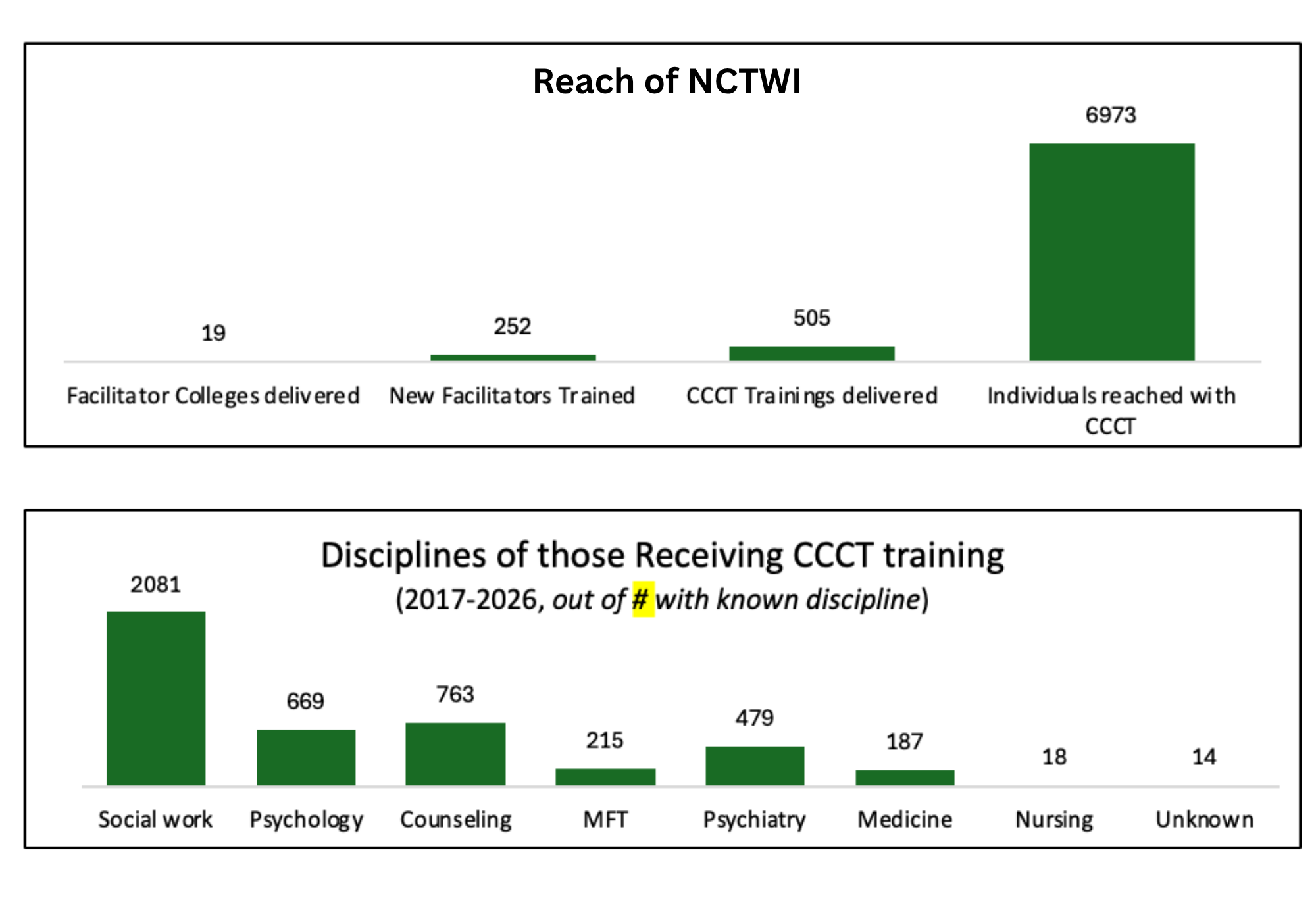
Impact on Training Participants
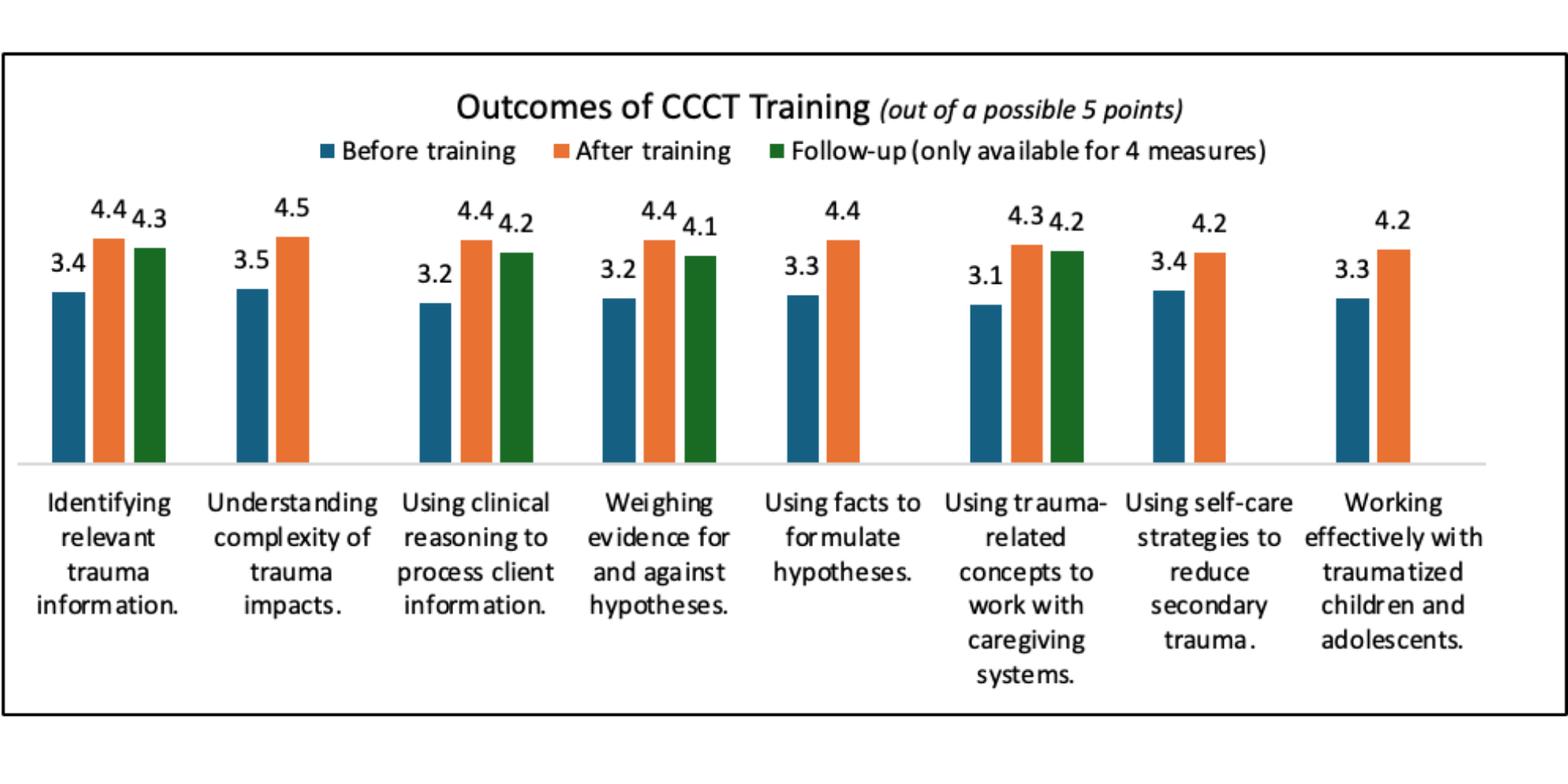
Since 2017, evaluation of nearly 2000 CCCT trainees has shown statistically significant improvement for eight core child trauma skills. These improvements were seen both immediately following CCCT training and in follow-up surveys 6-24 months post-training. Statistically significant improvements were consistent across discipline, experience level, practice setting, and training format.
Individuals trained to facilitate the CCCT have also shown statistically significant learning and skill development (effect sizes ranged from .90 to 2.25) in the following eight areas:
· Ability to clearly specify child trauma related learning objectives based on the specific training audience and training aims.
· Ability to select appropriate child trauma learning tools/activities based on specific training learning objectives.
· Understanding of the 12 Core Concepts and how they relate to the CCCT cases.
· Ability to guide training participants in applying the 12 Core Concepts to hypothesis generation and testing.
· Ability to facilitate the basic PBL process (eliciting relevant facts, hypotheses, next steps, learning issues; guiding questions).
· Ability to teach others to understand the complex impacts of trauma on children and adolescents.
· Ability to increase the clinical reasoning abilities of newer mental health practitioners.
· Ability to help learners develop self-care and stress management strategies to manage secondary traumatic stress reactions.